

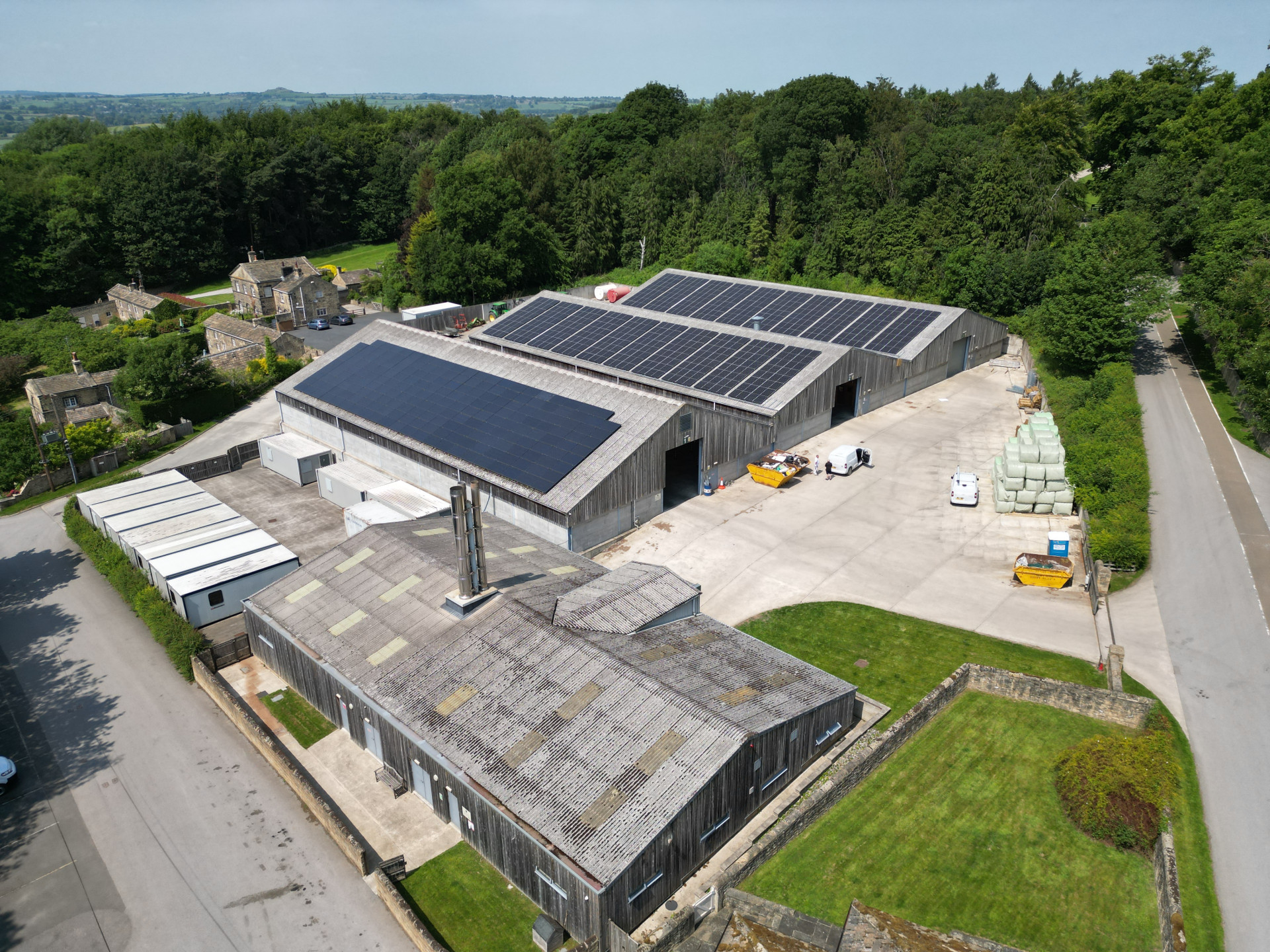
One of the most common questions we hear about commercial solar is: “Does my roof need to face south?”
The short answer is no.
If your only objective is to generate the maximum possible amount of electricity from each individual solar panel, then a south-facing roof is generally the ideal starting point.
But commercial solar design is rarely quite that simple.
What if your building faces east or west? What if you have a large, shallow-pitched north-facing roof? Or what if the most important thing to your business is not simply generating as much electricity as possible, but making sure you actually use as much of that solar electricity as possible?
For a commercial solar project, when the electricity is generated can be just as important as how much is generated.
Here is how the different orientations compare.
South-facing solar panels
A south-facing solar array produces the generation profile most people associate with solar.
Generation gradually increases through the morning as the sun rises, reaches its highest point around the middle of the day and then falls away through the afternoon.
If you plotted it on a graph, you would normally see a fairly conventional bell-shaped curve.
The main advantage is straightforward: a south-facing panel will typically produce more electricity over the course of a year than the same panel facing another direction.
But there can be a drawback.
If your business does not use much electricity around the middle of the day, the point at which your solar system is generating the most electricity may also be the point at which you are least able to use it.
That can result in more electricity being exported to the grid.
For some businesses that is absolutely fine.
For others, particularly where maximising on-site consumption is important, another orientation may actually produce a more useful generation profile.
East-facing solar panels
An east-facing solar array naturally produces more of its electricity earlier in the day.
Generation starts strongly as the sun rises and then gradually reduces as the sun moves across the sky.
That can make east-facing roof space particularly attractive for businesses with significant morning electricity demand.
Think about a manufacturing facility starting machinery early in the day, a food-production business beginning operations before normal office hours or any site with a strong morning load.
In those circumstances, slightly lower annual generation can be offset by the fact that the electricity is being produced at exactly the time the business needs it.
And electricity used directly on site is normally far more valuable to a business than electricity unnecessarily exported to the grid.
West-facing solar panels
West-facing solar works in broadly the opposite way.
Generation will typically be lower during the morning before increasing as the day progresses, with stronger production extending further into the afternoon.
For businesses whose electricity consumption remains high later in the day, that can be extremely useful.
Again, the important question is not simply:
“Which direction generates the most electricity?”
It is:
“Which generation profile best matches how my business actually uses electricity?”

East-west solar arrays
For many commercial buildings, combining east and west-facing panels can produce a very useful generation profile.
Instead of creating one pronounced peak around midday, generation is spread across a longer proportion of the working day.
The east-facing panels contribute more strongly during the morning before the west-facing panels take over later in the day.
The result is normally a broader, flatter generation curve.
For a business with relatively consistent daytime electricity consumption, that can help increase self-consumption and reduce the amount of electricity exported.
There can also be another advantage.
On flat commercial roofs and some ground-mounted systems, an east-west configuration can allow more solar panels to be installed within a given area.
Traditional south-facing rows need to be spaced sufficiently far apart to prevent one row shading the next.
East-west mounting systems can often be installed much more densely, allowing considerably more of the available area to be utilised.
That means a system which generates slightly less per panel may actually allow more panels to be installed overall.
Can you put solar panels on a north-facing roof?
This is where things get a little more interesting.
North-facing roof space is often dismissed immediately.
But on commercial buildings, particularly those with shallow roof pitches and high electricity consumption, it should not automatically be ruled out.
Solar panels do not generate electricity solely from direct sunlight. They can also generate from diffuse solar radiation — essentially daylight scattered through the atmosphere.
A steep north-facing domestic roof may therefore be relatively unattractive.
A very shallow commercial roof can be a different proposition.
Would we normally use north-facing roof space before south, east or west-facing areas?
No.
But once the better-performing areas of a building have been utilised, there can be circumstances where adding panels to a shallow north-facing elevation makes commercial sense.
This is particularly true where the business has sufficient electricity demand to consume the additional generation.
There is also an economy-of-scale consideration.
Many of the costs associated with a commercial solar installation do not increase proportionally with every additional panel. As a project gets larger, the installation cost per panel or per installed kWp can often reduce.
Lower generation does not therefore automatically mean poorer economics.
The numbers need to be modelled.
So, which direction is best for solar panels?
There isn’t one answer.
If the sole objective is to maximise annual electricity generation from each individual panel, south-facing will normally be best.
But that doesn’t mean every commercial solar array should simply point south.
An east-facing system may work particularly well for a business with strong morning demand.
A west-facing system can extend useful generation later into the day.
An east-west array can create a broader generation profile and make very effective use of available roof space.
And in the right circumstances, even shallow north-facing roofs can contribute to a commercially attractive solar project.
That is why we believe commercial solar should be designed around the business underneath the roof, rather than the roof in isolation.
At Westwood Energy, we look at how and when a site uses electricity before determining the most appropriate solar design.
The objective might be maximum generation.
It might be maximum self-consumption.
It might be the shortest possible payback period.
Or it might be creating the right foundation for future battery storage.
The important thing is that the system is designed around the outcome the customer is actually trying to achieve.
So instead of asking:
“Does my roof face the right way for solar?”
A better question is:
“How do we make the roof I have work hardest for my business?”
If you would like to understand what the different roof areas on your site could deliver, speak to the Westwood Energy team.
